Create Your Own Online Marketplace with LALA MyStore
Build a platform where multiple sellers list and sell under your brand — with seller onboarding, split payouts, admin controls and India-first compliance built in.

- No coding needed
- UPI, card & COD
- GST invoices
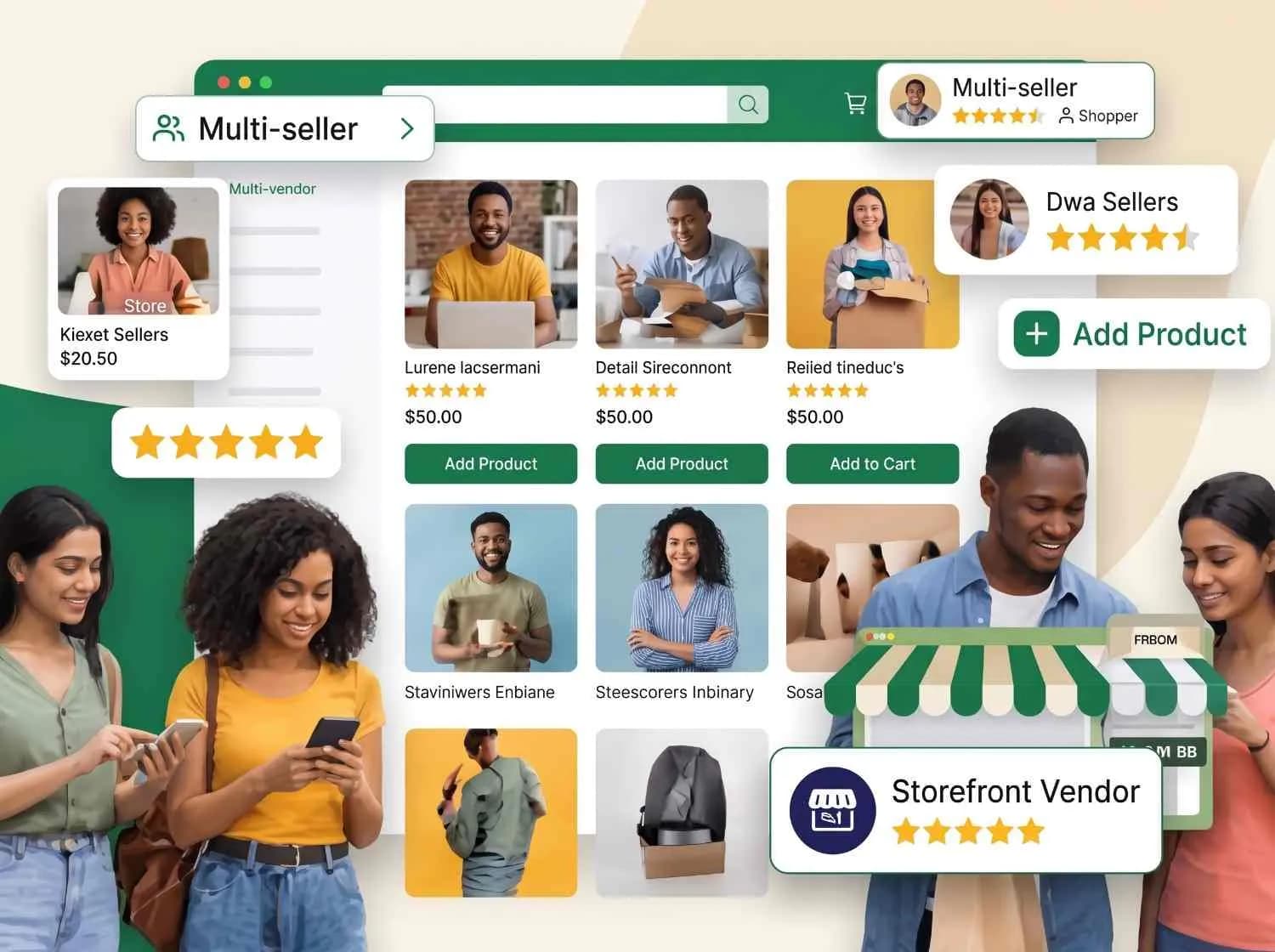
Why Online Marketplace Website Owners Need an Online Store
A marketplace is not a bigger version of an online store. It is a platform where independent sellers bring the supply, and your value is discovery, trust and fulfilment coordination. That distinction changes what you need to build.
Before you start, ask honestly: will sellers manage their own listings and ship their own orders? If yes, you need marketplace software. If you own the stock and set the prices, a single-seller store is simpler and often the right first step.
A marketplace needs three products in one: a buyer storefront, a seller panel and an admin console. The seller panel is where supply lives or dies — if onboarding is painful, sellers will not keep their listings up to date.
Payments are the hardest part. The buyer pays once, but the money belongs to several parties. Use a payment aggregator's split-payment product rather than collecting everything into your own account and paying sellers manually.
Compliance is a product feature, not an afterthought. Seller details, grievance tickets, return policies, ranking disclosures and TCS collection all need to be built into your platform from day one, not retrofitted after launch.
The problem
Marketplaces are far more complex than single-seller stores, with seller onboarding, payouts and disputes.
The fix
LALA MyStore provides the seller panel, admin console and buyer storefront in one ecosystem, so you build the platform rather than the plumbing.
The problem
Collecting all payments into your account and paying sellers manually creates reconciliation chaos.
The fix
Use split-payment infrastructure that transfers each seller's share automatically after deducting commission, with holds until delivery is confirmed.
The problem
India's marketplace compliance rules are detailed and changing, including 2027 amendments.
The fix
Build seller disclosures, grievance tickets, ranking transparency and TCS collection into your platform from day one rather than retrofitting.
Features for Online Marketplace Website Owners
Buyer storefront
A searchable marketplace frontend where customers browse products from multiple sellers.
Seller panel
Sellers manage their own listings, inventory, orders and payouts from a dedicated dashboard.
Admin console
Approve sellers, moderate listings, set commission rules and handle disputes from one place.
Split payments
Use payment aggregator split products to transfer each seller's share after deducting commission.
GST & TCS compliance
GST invoicing and TCS collection under Section 52 built into the payout workflow.
Marketplace analytics
Track seller performance, order volume, commission revenue and buyer behaviour.
Manage Online Marketplace Website Products and Categories
Set up your marketplace with seller onboarding and KYC capture, catalogue moderation, commission rules by category or seller tier, split-payment configuration with settlement holds, and a grievance module that gives every complaint a trackable ticket number. Manage sellers, orders, payouts and disputes from one admin console.
- Bulk upload from Excel
- Categories and sub-categories
- Stock tracking per product
- MRP and offer price
- Product specifications
- HSN code and GST rate
- Units like kg, litre, piece or metre
- Active, draft and archived status
Marketplace models you can build
- Niche B2C marketplace (single category)
- Hyperlocal marketplace (city or region)
- B2B marketplace with RFQ and credit
- Services marketplace
- Handmade and artisan marketplace
- Fashion and lifestyle marketplace
- Grocery and essentials marketplace
- Electronics and appliances marketplace
- Home and furniture marketplace
- Books and stationery marketplace
- Health and wellness marketplace
- Multi-category marketplace
Reach More Customers Online
Marketplaces grow by solving the chicken-and-egg problem: sellers are often easier to onboard first because they are seeking new sales channels, and a marketplace with empty shelves stalls before it starts [citation:8]. Recruit a small number of high-quality sellers in one category, launch to buyers through hyper-local marketing, and expand only once the first market shows healthy repeat rates and seller retention [citation:1].
- Recruit your first sellers directly before you launch to buyers
- Start with one category and one geography rather than launching broad and thin
- Use the first sellers' existing customer relationships to drive early referrals
Your own store link
Every store gets its own web address to share anywhere.
Store QR code
Customers scan at your counter, on bills or on posters to open your store.
WhatsApp & social media
Share products and offers on WhatsApp, Instagram and Facebook.
Google search & custom domain
Set your store's SEO details and use your own domain name.
How to Create Your Online Marketplace Website with LALA MyStore
Step 1
Sign up and name your store
Create your free LALA MyStore account and add your online marketplace website's name, logo, address and contact details.
Step 2
Choose a store template
Pick a design that suits your online marketplace website and add your banner and cover photos.
Step 3
Add your products
Upload your online marketplace website products from Excel or add them one by one, with prices, stock, photos and categories.
Step 4
Set up payments and delivery
Turn on UPI, card and cash on delivery, add your GST details and decide where you deliver.
Step 5
Share and start selling
Share your store link and QR code on WhatsApp, Instagram and at your counter, and manage orders from your dashboard.
Everything You Need to Know About Selling Online
Create an online marketplace website with LALA MyStore and build a platform where multiple independent sellers list and sell their products under your brand. A marketplace is fundamentally different from a single-seller online store: you are not just taking orders, you are onboarding sellers, managing payouts, handling disputes and answering for products you never touched [citation:10]. This marketplace website builder gives you the seller panel, admin console and buyer storefront in one ecosystem. Before you commit to building a marketplace, ask yourself an honest question: will sellers manage their own listings and ship their own orders? If the answer is no — if you upload everything and sellers just send you stock — you may need a normal store with supplier records, not a marketplace [citation:8]. LALA MyStore supports both models, so you can start with a store and add marketplace capabilities as your seller network grows.
A marketplace needs three distinct products that share one database: the buyer experience, the seller panel and the admin console. Most founders over-invest in the buyer storefront and under-invest in the other two [citation:10]. The seller panel is where your supply lives or dies — if onboarding is painful, KYC capture is clunky or catalogue upload is one-product-at-a-time, sellers will not keep their listings up to date [citation:10]. The admin console is where your operations team spends every day: approving sellers, moderating listings, setting commission rules, handling refunds and disputes, and managing payout holds [citation:10]. Get these two right and the buyer experience follows. Get them wrong and no amount of storefront design will save you.
Payments are where marketplaces get into trouble. The buyer pays once, but that payment belongs to several parties: the seller, your platform commission, sometimes a logistics partner, and taxes [citation:10]. The clean way to handle this in India is through a payment aggregator's split-payment product — the buyer pays once, and the platform transfers each seller's share to a linked account after deducting commission, often holding funds until delivery is confirmed or the return window closes [citation:10]. Whatever provider you choose, build these rules into your system: commission logic by category or seller tier, settlement holds until delivery is confirmed, refund reversals that pull back the seller's share automatically, and seller statements showing each order, commission and payout [citation:10]. If you collect everything into your own account and pay sellers manually, you create reconciliation work that grows faster than your order volume.
Compliance is not an afterthought for marketplaces — it is a product feature. Under India's Consumer Protection (E-Commerce) Rules, a marketplace must display seller details (business name, address, customer care number, ratings), give every complaint a trackable ticket number, explain return and refund terms, and publish the main parameters that decide how products and sellers are ranked [citation:10]. From 1 January 2027, amendments add further requirements: sponsored listings must be clearly labelled, search results must not be misleadingly manipulated, any discount must show the prior price (lowest in the last 30 days), and a yearly dark-pattern self-audit certificate must be displayed [citation:10]. GST registration is generally mandatory for e-commerce operators regardless of turnover, and you must collect TCS under Section 52 of the CGST Act [citation:7]. Building these requirements in from day one costs far less than retrofitting them after launch.
For founders comparing options, the right way to build a marketplace depends on your stage and how much customisation you need. Ready-made scripts and plugins can get a demo running quickly and are a reasonable way to test whether sellers will even sign up [citation:10]. But they strain when your commission or payout rules do not fit their settings, when you need B2B pricing or quotes, or when the new disclosure and grievance requirements are not supported [citation:10]. A sensible custom route is a focused first version: one category, one city or region, seller onboarding, catalogue moderation, checkout with split payments, and a basic grievance module [citation:10]. Ratings, sponsored placements, loyalty and mobile apps follow once you know what sellers and buyers actually do. Whether you start with a single-seller store on LALA MyStore or build toward a multi-vendor marketplace, the key is to launch tight and iterate based on real seller and buyer behaviour rather than feature lists.
Frequently Asked Questions
Do I need a marketplace or a single-seller store?
If sellers will log in, list their own products, ship orders and get paid separately, you need a marketplace. If you own the stock and set the prices, a single-seller store is simpler and often the right first step [citation:8].
How do payments get split between sellers and the platform?
Through a payment aggregator's split-payment product. The buyer pays once, and the platform transfers each seller's share to a linked account after deducting commission, often holding funds until delivery or the return window closes [citation:10].
Is GST registration mandatory for an online marketplace?
Generally yes. Under the CGST Act, e-commerce operators are typically required to register for GST irrespective of turnover, unlike regular sellers who benefit from a threshold exemption. Confirm your specific obligation with a CA [citation:7].
What is TCS under Section 52 and why does it matter?
Tax Collected at Source under Section 52 requires e-commerce operators to collect a specified percentage of the net taxable supply value made through their platform by other sellers and deposit it with the government. This needs to be built into your payout workflow [citation:7].
What compliance requirements apply to marketplaces in India?
Marketplaces must display seller details, provide trackable grievance tickets, explain return and refund terms, and publish ranking parameters. From January 2027, amendments add sponsored listing labels, prior price disclosure, and a yearly dark-pattern audit certificate [citation:10].
Should I build custom or use a ready-made marketplace script?
A ready-made script is fine to test demand in one category. Build custom when your commission logic, seller workflows, logistics or B2B pricing are the actual business advantage, or when you need compliance features the script does not support [citation:10].
What should the first version of my marketplace include?
A focused first version: one category, one city or region, seller onboarding, catalogue moderation, checkout with split payments, and a basic grievance module. Ratings, sponsored placements and mobile apps can follow [citation:10].
Can LALA MyStore support a marketplace model?
LALA MyStore provides storefront, seller management and order infrastructure that can support marketplace operations. Check the pricing page and contact support for details on multi-vendor capabilities and what is included in each plan.
How do I solve the chicken-and-egg problem of sellers and buyers?
Sellers are often easier to onboard first. Recruit a small number of high-quality sellers in one category, then launch to buyers through hyper-local marketing and the sellers' existing customer relationships [citation:8][citation:1].
Can I start with a single-seller store and add marketplace features later?
Yes. Many founders start with a single-seller store to validate demand, then add seller management and split payments as the business grows. The platform should support this progression without forcing a rebuild.
Solutions for other businesses
Online store for multi-store ecommerce managements
Manage multiple stores, warehouses and sales channels from one dashboard. Centralise your catalogue, sync inventory, process orders and grow your retail network with LALA MyStore.
Online store for best ecommerce platforms
Find the best ecommerce platform in India for your business. Compare marketplaces, Shopify, WooCommerce and free builders like LALA MyStore based on stage, budget and needs.
Online store for online store for businesss
Create an online store for your business with LALA MyStore. List products or services, accept UPI and COD payments, manage orders and start selling online without upfront costs.
Ready to take your online marketplace website online?
Build your branded online store, accept payments and send GST invoices — all from one dashboard.