Manage All Your Stores in One Platform with LALA MyStore
Centralise your product catalogue, inventory and orders across every store, warehouse and sales channel. Add new outlets, sync stock in real time and grow your retail network without adding administrative overhead.

- No coding needed
- UPI, card & COD
- GST invoices
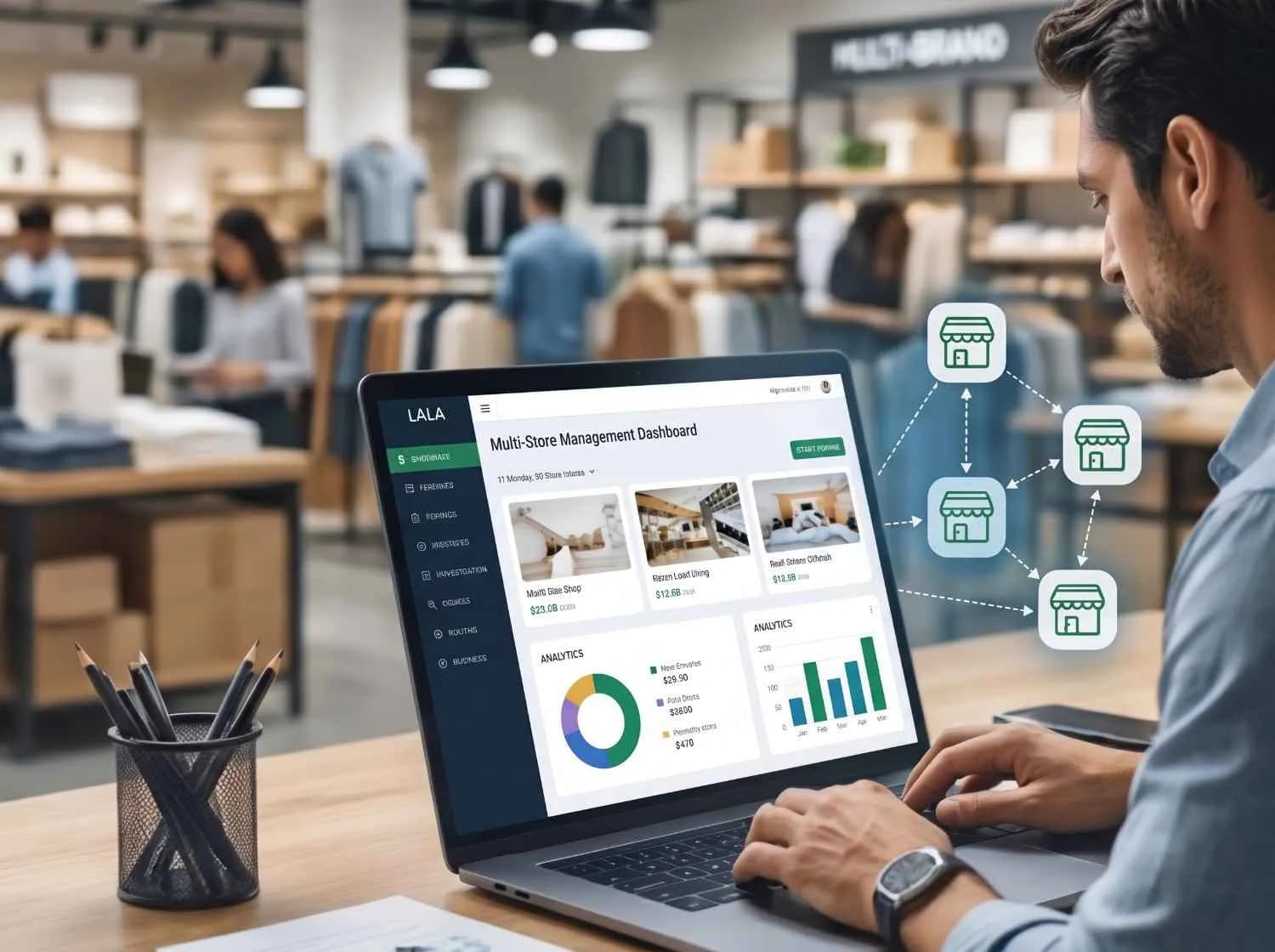
Why Multi-Store Ecommerce Management Owners Need an Online Store
Running multiple stores usually means running multiple systems — separate catalogues, separate stock counts, separate order queues. A multi-store ecommerce management platform brings all of that into one dashboard, so your team manages the business, not the software.
Your central catalogue is the single source of truth for products, prices and descriptions. Each store or channel can draw from that catalogue while maintaining its own stock levels, local offers and delivery settings.
When an order comes in — whether from your website, a marketplace or a walk-in customer — it routes to the right store or warehouse for fulfilment. Real-time inventory sync prevents overselling and keeps stock accurate across locations.
Store-wise and channel-wise reports show which locations perform best, which products move fastest and where stock needs replenishing. Centralised customer data lets you recognise and reward buyers across your network.
Whether you are opening your second outlet, managing a franchise network or adding new sales channels, the right multi-store platform grows with you — adding stores in minutes, not rebuilding your systems from scratch.
The problem
Each store runs on separate systems with no central visibility.
The fix
A shared product catalogue and one order dashboard connect every store, warehouse and sales channel.
The problem
Stock counts don't match between locations, causing overselling.
The fix
Real-time inventory synchronisation across channels prevents stock mismatches and overselling.
The problem
Adding a new store means rebuilding listings and systems from scratch.
The fix
New stores draw from the same central catalogue and can be added in minutes without duplicating work.
Features for Multi-Store Ecommerce Management Owners
Central store dashboard
Manage every store, warehouse and channel from one login and one operating view.
Shared product catalogue
Update products, prices and descriptions once and push changes across every store.
Real-time inventory sync
Keep stock accurate across locations and channels to prevent overselling [citation:2].
Bulk catalogue upload
Import your full product range from Excel and assign availability per store.
Learn more about bulk catalogue uploadGST invoicing
Generate GST invoices for orders across every store and channel.
Learn more about gst invoicingStore-wise reports
See sales, stock and performance by store and channel in one place.
Learn more about store-wise reportsManage Multi-Store Ecommerce Management Products and Categories
Add each store or channel from your central dashboard, assign which products and stock are available at each location, and configure store-specific delivery and payment options. Upload your catalogue from Excel once and map stock across locations. Use bulk updates for price changes, and add new stores in minutes by drawing from the same central catalogue.
- Bulk upload from Excel
- Categories and sub-categories
- Stock tracking per product
- MRP and offer price
- Product specifications
- HSN code and GST rate
- Units like kg, litre, piece or metre
- Active, draft and archived status
Businesses that use multi-store management
- Retail chains with multiple outlets
- Franchise networks
- Supermarkets with branches
- Garment and footwear chains
- Electronics and appliance dealers
- Hardware and building material stores
- Pharmacies with multiple locations
- D2C brands selling on marketplaces
- Wholesale and distribution networks
- Seasonal or pop-up stores
- Regional warehouses
- Omnichannel retail operations
Reach More Customers Online
Multi-store businesses serve customers across a wider geography than single-location shops. A centralised platform lets you maintain consistent pricing, stock and service across every location while still allowing each store to respond to local demand.
- Use store-wise reports to identify which locations need more stock or targeted offers
- Share a single store locator link so customers can find the nearest outlet
- Run network-wide offers while letting individual stores add local promotions
Your own store link
Every store gets its own web address to share anywhere.
Store QR code
Customers scan at your counter, on bills or on posters to open your store.
WhatsApp & social media
Share products and offers on WhatsApp, Instagram and Facebook.
Google search & custom domain
Set your store's SEO details and use your own domain name.
How to Create Your Multi-Store Ecommerce Management with LALA MyStore
Step 1
Sign up and name your store
Create your free LALA MyStore account and add your multi-store ecommerce management's name, logo, address and contact details.
Step 2
Choose a store template
Pick a design that suits your multi-store ecommerce management and add your banner and cover photos.
Step 3
Add your products
Upload your multi-store ecommerce management products from Excel or add them one by one, with prices, stock, photos and categories.
Step 4
Set up payments and delivery
Turn on UPI, card and cash on delivery, add your GST details and decide where you deliver.
Step 5
Share and start selling
Share your store link and QR code on WhatsApp, Instagram and at your counter, and manage orders from your dashboard.
Everything You Need to Know About Selling Online
Manage multiple stores, warehouses and sales channels from one dashboard with a multi-store ecommerce management software built for growing retail businesses. Whether you run several physical outlets, a network of franchise stores, or a combination of your own website and marketplaces like Amazon and Flipkart, this platform lets you centralise your product catalogue, inventory, orders and customer data so every location stays in sync. Instead of juggling separate logins, spreadsheets and manual stock checks, you get one operating layer across your entire retail footprint. Real-world deployments show the scale this can handle — brands like Woodland manage up to 4,500 orders per day across 171 stores and a central warehouse through a unified commerce platform [citation:2][citation:14].
The core value of multi-store management is centralised control without losing store-level flexibility. A shared product catalogue lets you update prices, descriptions and stock once, and push changes across every store and channel [citation:7]. At the same time, each store can maintain its own inventory, theme, payment methods and local offers — so a franchise in one city can run a local promotion without affecting the flagship store. Customer records are shared across the network, which means a buyer who shops online and in-store is recognised as the same customer, with a complete order history that supports loyalty and repeat-purchase strategies [citation:1].
Setting up multi-store management is straightforward for retail businesses already selling through LALA MyStore. Add your additional stores or sales channels from the dashboard, assign which products and stock are available at each location, and configure store-specific delivery and payment options. Upload your full catalogue from Excel, map stock across locations, and use bulk updates to change prices or availability across all stores at once. When a new outlet opens or a seasonal store launches, it can be added in minutes and draw from the same central catalogue — no need to rebuild listings from scratch.
Day-to-day operations become far simpler when every order flows into one queue. Online orders, in-store sales and marketplace orders appear together, with clear indicators of which store or warehouse should fulfil each order. Real-time inventory synchronisation prevents overselling across channels — when stock runs out at one location, the system reflects that everywhere [citation:2]. GST invoicing, order notifications and channel-wise sales reports help your team manage compliance and understand which stores and channels are performing best, without exporting data from multiple systems into spreadsheets.
For retail businesses planning to grow beyond a single location, a multi-store ecommerce management platform provides the operational foundation to scale without adding proportional administrative overhead. Whether you are opening your second outlet, adding a franchise network, or expanding to new cities, the same central catalogue and order management system supports each new store from day one. Review store-wise and channel-wise sales reports to identify high-performing locations, use centralised customer data to run targeted offers across your network, and keep your entire retail operation visible in one place — so growth is a matter of adding stores, not rebuilding your systems.
Frequently Asked Questions
What is multi-store ecommerce management software?
It is a platform that lets you manage multiple stores, warehouses and sales channels from one dashboard, with a shared product catalogue, centralised inventory and unified order management.
Can I manage multiple physical stores and my online store together?
Yes. You can connect your physical outlets, your website and your marketplace channels in one platform, with shared inventory and a single order dashboard.
How does inventory stay accurate across stores?
Real-time inventory synchronisation updates stock levels across all locations and channels, so a sale at one store is reflected everywhere and overselling is prevented [citation:2].
Can each store have its own pricing and offers?
Yes. While the central catalogue provides the base product information, individual stores can maintain their own stock, local offers and delivery settings.
How long does it take to add a new store?
New stores can be added in minutes from your dashboard and draw from the same central catalogue, so you do not need to rebuild listings or systems from scratch.
Can I see which store is performing best?
Yes. Store-wise and channel-wise sales reports show revenue, order volume and stock movement by location, so you can identify high-performing stores and address underperformers.
Does the platform support GST invoicing across stores?
Yes. LALA MyStore supports GST invoicing for orders across every store and channel, with product tax details configured correctly.
Can I manage franchises with different owners?
Yes. The platform supports franchise and reseller networks where central product and inventory management is combined with store-level operational control [citation:1].
What happens when stock runs out at one store?
Real-time sync reflects the updated stock everywhere. You can choose whether another location fulfils the order or whether the product is marked unavailable for that store.
Can I upload my full catalogue once and assign it across stores?
Yes. Upload your catalogue from Excel once, then assign which products and stock are available at each store or channel.
Solutions for other businesses
Online store for omnichannel retail platforms
Run your shop and online store as one business with LALA MyStore's omnichannel retail ecommerce platform. Sync products, stock, orders and customers in one dashboard.
Online store for supermarkets
Create your own online supermarket with LALA MyStore. List products across every department, take home delivery orders and grow your sales online.
Online store for best ecommerce platforms
Find the best ecommerce platform in India for your business. Compare marketplaces, Shopify, WooCommerce and free builders like LALA MyStore based on stage, budget and needs.
Ready to take your multi-store ecommerce management online?
Build your branded online store, accept payments and send GST invoices — all from one dashboard.